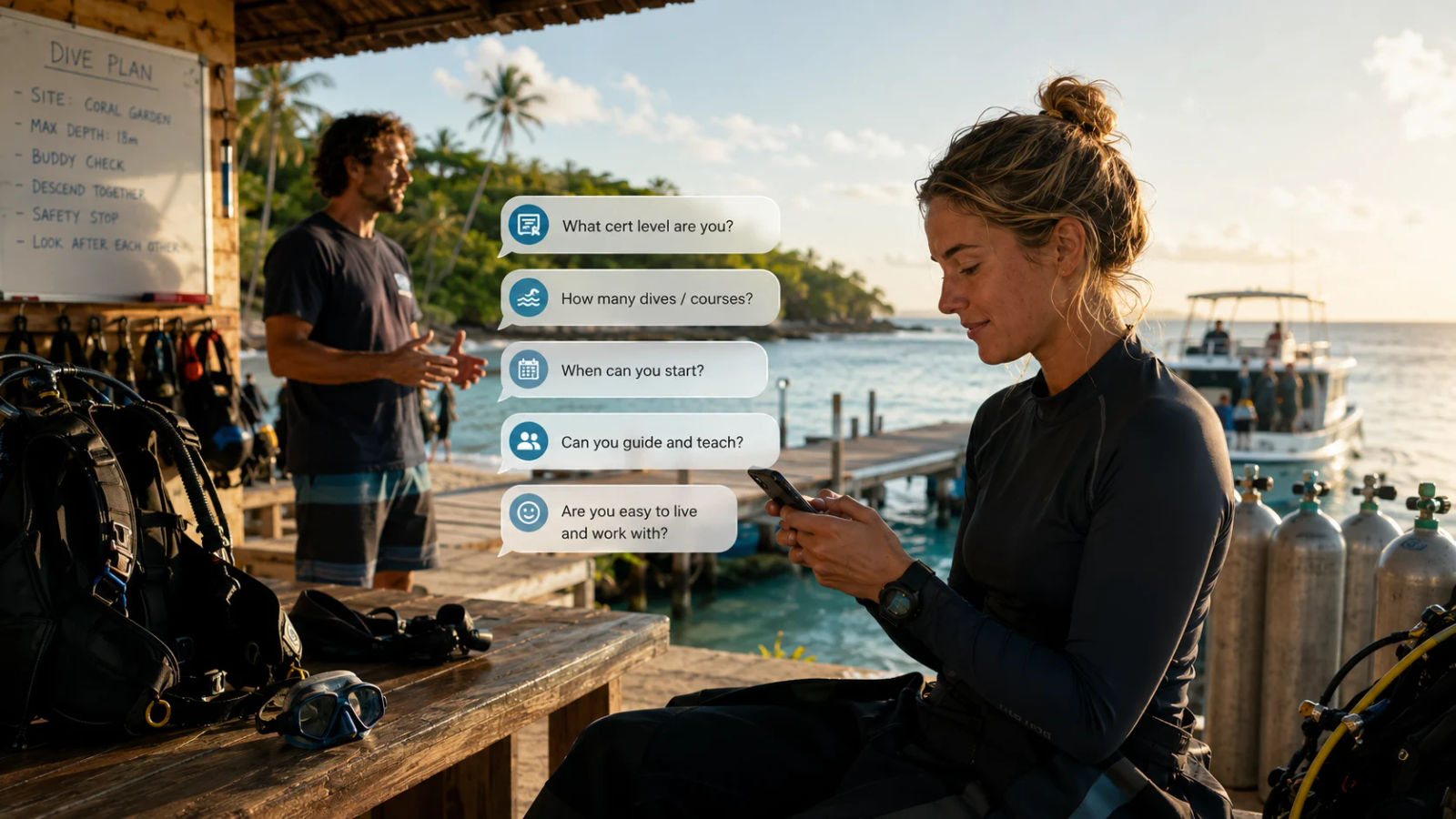
What a dive industry interview is actually like
A dive shop or resort interview is rarely a formal sit-down. The most common format is a 10-to-20-minute WhatsApp voice call, occasionally a video call, occasionally an in-person chat after you've already shown up at the shop. Liveaboards run slightly longer interviews because the stakes of crew incompatibility are higher; resort dive bases sometimes do two rounds (operations manager, then dive base supervisor).
The operator is usually doing this between dive boats, so expect short answers and conversational pacing. They are not testing whether you can recite agency standards. They are working out whether you'll be useful, easy to work with, and still there in three months.
The credentials sanity-check
The first 2 to 3 minutes confirm your CV is real. These questions feel obvious but they're not throwaway: operators have been burned by candidates exaggerating logged dives or claiming ratings they're still mid-paperwork on. Be precise.
- "How many logged dives do you have?" They want a real number, not an estimate. Round down if you're unsure.
- "Where did you do your IDC?" Probing the network. Your Course Director's name may matter; a respected CD is a quiet endorsement.
- "What agencies are you certified with?" Mostly checking for the agency they teach, but also whether you have a useful cross-cert.
- "When did you last teach?" Long gaps raise a flag. Have an answer ready that explains the gap honestly (off-season work, family, travel).
- "What's your dive insurance and first-aid status?" Both need to be current. If lapsed, say so and add when you'll renew.
- "What's your passport and visa situation?" The one that quietly disqualifies more candidates than anything else. Be specific about timing.
The operational and technical round
Now they want to know you can actually do the job. Most operators don't grill on standards; they probe instincts. Generic answers ("safety is my priority") read as inexperienced. Specific answers ("I run a buddy-check on every dive even when guests insist they don't need it because I've found three free-flowing first stages mid-check this year") read as someone who's been on the boat.
- "Walk me through a typical morning at your last shop." Probing your routine, your familiarity with operational rhythm, and whether you actually worked the role you claim.
- "What size group are you comfortable teaching?" They want a real number plus a caveat ("Up to 6 students for Open Water, 8 for Advanced Open Water, smaller groups for nervous beginners or kids").
- "How do you handle a panicked diver?" They want sequence, not theory. Eye contact, controlled ascent if needed, surface and stabilise, debrief calmly later.
- "What's your max depth comfortable, and what's your hardest dive site?" Calibrating you for their conditions. Currents, depth, viz changes, surface conditions.
- "Have you taught Discover Scuba in choppy / poor-viz / cold-water conditions?" Probing whether their conditions will surprise you.
- "What's your comfortable equipment standard for student rentals?" Soft answer: anything that's serviced and you've personally checked. Harder answer: ask about their gear pool before committing.
Situational judgment questions (where most candidates lose ground)
The single most important section of any dive interview. Operators ask hypotheticals because they want to see your decision-making under pressure: do you escalate sensibly, do you respect the chain, do you keep students safe before keeping a schedule. There's rarely one right answer, but there is a recognisable shape to a good one.
- "A student panics in the pool and bolts to the surface. What do you do?" They want sequence: control the rest of the group first, surface yourself, debrief with the student in private, decide whether to continue or postpone, document in the training record.
- "Your co-instructor wants to skip the buddy check because the group is running late. What do you say?" They want you to push back without being a hero about it: privately, professionally, frame it around the student's safety. Diving operators value people who hold a line without making a scene.
- "On the boat back you realise you've miscounted divers. First move?" Recount calmly, call surface positions, recall the dive, alert the captain. They want to see structure, not panic.
- "You get to the dive site and conditions are marginal but inside agency standards. The guests are paying customers and want to go. What do you do?" The right answer is operator-dependent; what they're checking is whether you'll take the conservative call when needed, and whether you can communicate it to the guests without losing them as customers.
- "Your DSD student refuses to put their head under in the pool. What's your next 10 minutes?" Probing your patience, your toolbox of techniques, and whether you'll cut the program kindly if it's not working.
Personality and crew-fit questions
For resort and liveaboard operators in particular, crew-fit matters as much as competence. You'll often be living with the team. They are reading temperament here as much as listening to content.
- "Why are you leaving your current shop?" Universally asked. Bad answer: criticism of the previous owner. Good answer: a specific reason that points forward (season ended, looking for a longer contract, want to teach more advanced courses).
- "How do you handle long hours and tired guests at the end of the season?" They are looking for pattern recognition, not platitudes. Specifics about pacing yourself help.
- "What do you do when you disagree with a co-instructor on a teaching call?" They want to know you'll discuss in private and present a unified front to students.
- "Tell me about a time you had a difficult student or guest." Have one real story. Avoid the temptation to blame the guest.
- "How do you take feedback?" The closest most dive interviews come to a corporate question. Short, specific, calm.
Languages and guest demographics
Almost every operator outside the Anglosphere will ask this. Honesty pays: claiming a language you can only handle in tourist-script Spanish is exposed on the first morning.
- "What languages do you teach in conversationally?" Conversationally is the key word. Briefing a deep dive is harder than ordering lunch.
- "What guest demographics have you taught before?" Russian, German, Italian, Mandarin, French and Japanese groups all have specific service expectations. Operators flag instructors who can switch between them.
- "How do you brief mixed-language groups?" Practical answer: brief in the dominant language, then short recaps in each minority language for key safety points. They want to know you've thought about it.
- "Have you taught families with young children?" Resorts ask this often. They are checking for patience and pace.
Logistics and commitment
The closing section of most interviews. Cleanly answered, this is also where you set up the offer.
- "When can you start?" Always have a real date. "Available immediately" is fine if true; if you have a notice period, name the date you can fly.
- "How long are you looking to commit?" Most resorts and liveaboards want at least a full season (4 to 6 months minimum). Saying "I'll see how it goes" reads as flight risk.
- "Do you have your own gear?" Yes or no, both fine. If yes, list the brand and condition; if no, ask about the shop's gear pool.
- "Do you need accommodation?" Most operators in Asia, the Red Sea and the Maldives include it; Mediterranean and Caribbean shops often don't. Be specific about your expectation.
- "What's your salary expectation?" The single most awkward question. The honest answer is to ask their range first ("What's your typical package for this role?"). If pressed, give a range based on regional norms; salaries are covered in detail in our regions guide.
Questions you should ask back
The questions you ask are read as carefully as the answers you give. Asking nothing reads as desperate or careless. Asking the right things reads as someone who's done this before.
- Salary structure. Base, per-cert bonus, tips, accommodation, meals, gear use, days off. Get all of these named, not just headline cash.
- Day-off pattern. One in seven? One in ten? Fixed day or rotating? Operators that dodge this question often don't have a clean answer.
- How many other instructors / DMs are on the team. Three is healthy, one is a flag.
- What does a typical day look like. Their answer tells you almost everything about how the shop runs.
- How they handle weather days and dive cancellations. Especially in storm-risk regions. Some pay regardless, some don't.
- Trial day arrangements. Are you expected to do a working trial, paid or unpaid, how long, what's it covering.
- Who pays for what. Medicals, visa renewals, insurance, agency annual renewals: clarify each one.
- Contract. Is there a written one. What does it cover. When will you see it.
The working trial (it's part of the interview)
Many dive shops and resorts run a working trial before signing. This is the real interview. You're being watched on the boat, in the briefing, with guests, on the radio, and in the staff house at dinner. A great phone interview can come undone in a single day's trial; an average phone interview can be rescued by an excellent one.
What operators actually look for during a trial:
- Do you do the buddy check without being asked.
- Do you brief in a way the guests actually follow.
- Do you carry tanks, rinse gear and clean up after yourself without being asked.
- Do you respect the captain's timing.
- Do you behave the same way at lunch as you do on the boat.
- Do you stay calm when something small goes wrong.
Trial day arrangements vary. Some operators pay a day rate or a per-dive cash payment; some treat it as a free observation; some cover lunch and gear but no cash. Confirm what's on offer before you commit, but don't lose a strong role over a single trial day's pay.
What references actually get asked
Reference calls are short and direct. The operator already mostly trusts you by the time they call your references; they're calibrating their last 10% of doubt. Common questions your references get:
- "Would you re-hire them?" The most important question, and the one most heavily weighted. A "yes, without hesitation" carries more weight than five paragraphs of praise.
- "How did they handle difficult students or guests?" Probing for the kind of stories that don't make it into a CV.
- "How did they get on with the rest of the team?" Crew-fit again.
- "Did they ever cancel dives for safety reasons, and how did they handle it?" Probing for that conservative-judgment trait.
- "Were they reliable about admin (logbooks, paperwork, gear logs)?" An underrated question that quietly tips borderline hires.
- "Anything you'd want me to know that you haven't been asked?" The open-ended one. Strong references use this; weak ones don't.
You can pre-empt all of this by lining up references who've recently worked with you, briefing them on the role you're applying for, and giving them the operator's name in advance. Read our hiring-insight guide for the wider context on references.
Red flags from the operator (worth taking seriously)
Interviews go both ways. A few patterns from the operator's side are worth treating as data:
- No questions about your rescue or emergency experience. Suggests they're not running safety-first operations, or they're hiring desperately.
- Won't name a salary range, even when pushed. A common dynamic, and not always a flag, but ask twice. If they still won't, expect a low number.
- Won't show you a written contract before you arrive. Genuinely concerning. Operators that put nothing in writing are operators you can't hold to a promise.
- Don't ask for references. Either they don't care (which says a lot about their hiring standards) or they're skipping steps.
- Want you to start in 48 hours. Sometimes legitimate (someone quit, season opening pressure), but always worth a second question about why.
- Vague on accommodation, days off, or who pays what. Each one is a small flag; multiple at once is a real one.
- Speaks badly of previous instructors. The way they describe people who used to work for them is the way they'll describe you in six months.
A short pre-call checklist
Before you pick up the phone or open the WhatsApp call:
- Have your CV open on a second screen so numbers match.
- Know the operator's location, agency, recent reviews and roughly what their guest demographic looks like.
- Have one specific anecdote ready for "tell me about a difficult student / guest / dive day".
- Have a real start date in your head, not a vague "soon".
- Have two questions you'll ask back, written down where you can see them.
- Be somewhere quiet with signal you trust. Background noise reads as not-taking-it-seriously.
Final note
The dive industry hires on judgement, not credentials. Two instructors with identical certifications can interview wildly differently because one has built up a stock of specific stories and the other speaks in abstractions. The work of preparing for a dive interview is mostly the work of putting specific moments in front of mind: that panicked DSD, that broken first stage, that decision to call the dive when conditions turned, that night you carried a tired colleague's tanks. The interview is a quick conversation, but it's a conversation about you on a boat. Be ready to talk about what you've actually done there.
Find roles to interview for
- Scuba instructor jobs · open instructor roles globally
- Divemaster jobs · guiding-focused roles, often the entry to the industry
- Liveaboard jobs · boat-based contracts, where crew-fit weighs heaviest
- Dive resort jobs · seasonal teaching and guiding at island and coastal resorts