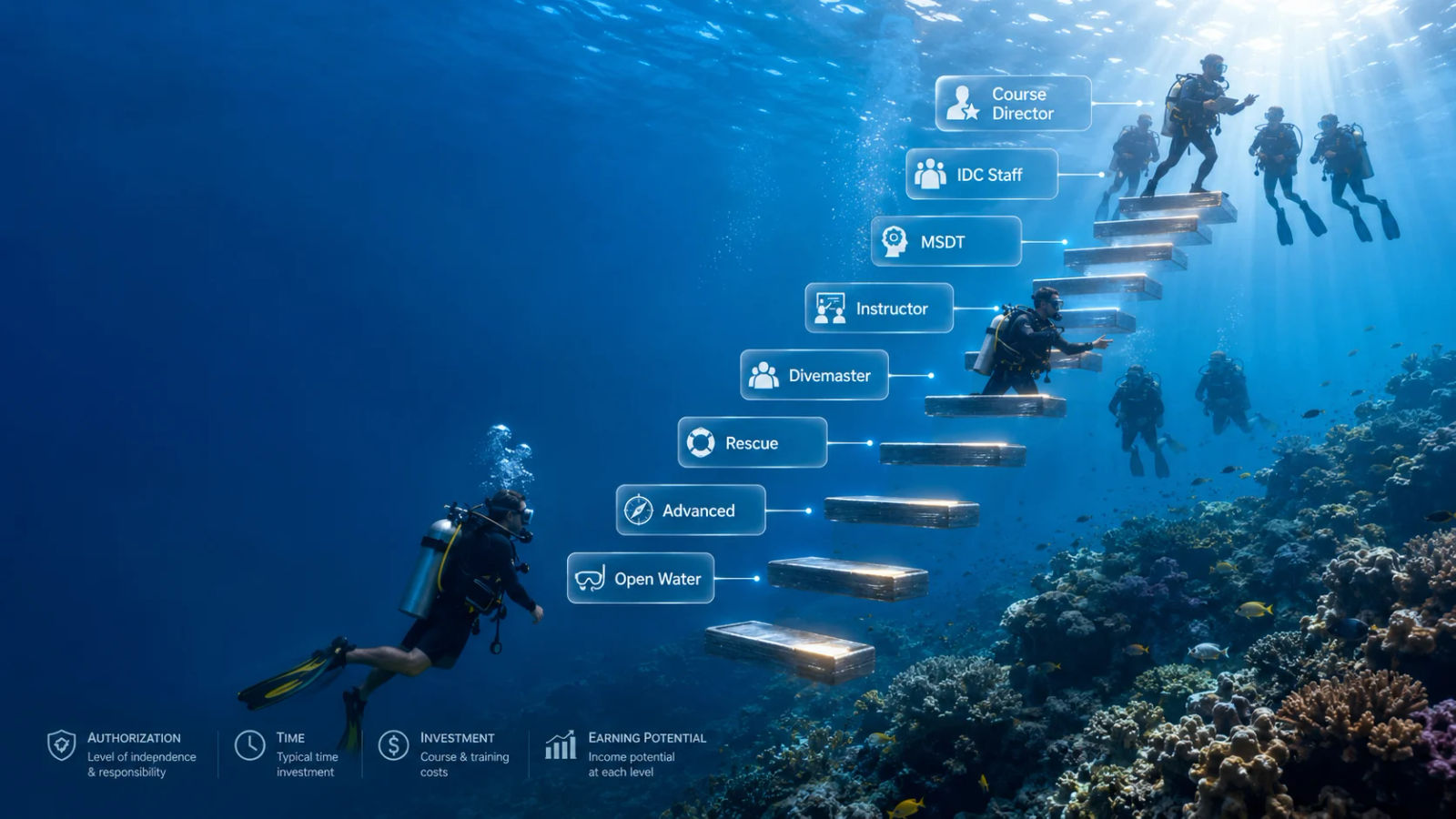
One ladder, two agency names
Every recreational dive agency operates the same essential career ladder. The names change between PADI, SSI, NAUI, SDI, RAID and the smaller agencies, but the rungs map onto each other almost exactly: a beginner certification, an advanced cert, a rescue cert, a professional rung that lets you assist instructors and guide certified divers, a teaching rung, several intermediate teaching ratings, and finally a teach-the-teachers rung at the top. If you're trying to decide between agencies before you start, read our PADI vs SSI guide first; this one stays agency-agnostic and uses generic terms where possible.
The ladder looks linear, and it mostly is. What people underestimate is the asymmetric difficulty: the first three rungs are a long weekend of effort each, the divemaster rung is a months-long shift in identity, the instructor rung is the biggest single leap in the industry, and everything above instructor is a slow accumulation of experience and student numbers. Most people who say "I want to be a dive instructor" are really committing to that one leap, not a continuous climb.
Rung 1: Open Water Diver
The entry rung. Open Water certifies you to dive to 18 metres with a buddy, without supervision, anywhere in the world the cert is recognised (effectively everywhere). It is a three-to-four-day course covering basic skills, theory, and four open-water training dives.
Time: 3 to 4 days, often spread over a week.
Cost: USD 300 to 600 in Western markets, USD 250 to 400 in Asia. Cheap-and-fast destinations (Koh Tao, Utila, Dahab) run constant high-volume Open Water courses at the lower end.
What it authorises: recreational diving to 18m with a buddy.
Job market relevance: none. This is not a career step, it is the qualification you happen to start from.
Rung 2: Advanced Open Water Diver
Five additional dives that extend your depth limit to 30 metres and introduce you to five specialty areas (deep, navigation, plus three of your choice, typically wreck, peak performance buoyancy and underwater photography or night). The course is short, low-pressure, and does not require any standalone skill tests.
Time: 2 to 3 days.
Cost: USD 250 to 400.
What it authorises: recreational diving to 30m, and the next rung up (Rescue) requires it.
Job market relevance: still none. Advanced Open Water is a prerequisite for the pro track, not a career step in itself.
Rung 3: Rescue Diver
The first rung that is genuinely demanding. Rescue covers in-water emergencies (panicked diver, unresponsive diver at depth, missing-diver searches), surface management, and the decision-making framework for dive accidents. Most people describe it as the most enjoyable course on the recreational ladder, and the one that teaches them the most.
Rescue requires current first-aid and CPR certification (PADI's Emergency First Response, SSI's React Right, or an equivalent like EFR Care for Children plus oxygen administration). Most dive centres bundle the first-aid cert with the Rescue course at a combined price.
Time: 4 to 5 days including first-aid.
Cost: USD 400 to 600 including first-aid.
What it authorises: still recreational diving, but you can now be the recognised "rescue-trained" buddy in a group. More importantly, you can now start the Divemaster course.
Job market relevance: threshold for pro training, no hiring at this level.
Rung 4: Divemaster (your first pro rung)
Divemaster is the first rung that lets you work in the industry. As a DM you can independently lead certified divers on guided dives, assist instructors during courses, and run refresher programmes for divers returning to the sport. You cannot teach courses that lead to certification.
The course is comparatively long: typically a four-to-eight-week internship at a dive shop, with a mix of theory, skills assessments, demonstration-quality skill demos, mapping exercises, and shadow-leading on real dive trips. Most shops run rolling DM internships that you can join at the start of any month. Many include free or discounted accommodation, in-house gear use, and unlimited fun diving as part of the package.
Time: 4 to 8 weeks of full-time effort. Prerequisites include at least 40 logged dives going in and 60 by the end, current first-aid, and 18 years old.
Cost: USD 700 to 1,200 for the course alone. Shop internships in Asia commonly bundle accommodation and unlimited diving into a USD 1,000 to 2,000 package; Western internships run USD 1,500 to 2,500.
What it authorises: guiding certified divers, assisting instructors, running discover-scuba briefings under instructor supervision (some agencies allow you to run the dives themselves with restrictions).
Pay realistically: entry-level DM pay is modest. Asia: USD 300 to 700 per month plus accommodation. Mediterranean and Caribbean: USD 600 to 1,400 per month, sometimes with tips. Maldives and high-end resorts rarely hire at DM level. Read our first-DM-job guide for the hiring side in detail.
Should you stop here? A meaningful number of people do. DM work is rewarding, you spend most of your day in the water, and the lower stakes suit people who don't want the teaching responsibility. If you mostly want to guide, DM is the rung.
Rung 5: Open Water Instructor
The big leap. Instructor (Open Water Scuba Instructor in PADI, Open Water Instructor in SSI, similar names elsewhere) authorises you to teach beginners through to Rescue Diver in your own right, with no instructor above you required for course oversight. This is the rung the dive industry actually hires for in volume.
The training has two parts. The Instructor Development Course (IDC) is around two weeks of intensive teaching practice, presentation skills, standards review, dive theory exams, and rescue scenario re-runs. The IDC is followed by the Instructor Examination (IE), a two-day independent assessment run by the agency directly. The pass rate for first-time IE candidates is high (PADI publishes around 95%) but the IDC itself is the actual gating workload.
Time: 2 to 3 weeks for the IDC, 2 days for the IE, often a 2-to-4-week break in between for self-study. From DM to certified instructor, plan for 6 to 10 weeks of effort.
Cost: USD 1,800 to 3,500 for the IDC + IE combined. Big training hubs (Koh Tao, Utila, Gili Islands, Tenerife) sit at the lower end. Premium IDC providers (Course Directors with strong reputations, smaller cohorts) sit higher.
What it authorises: teaching every recreational course from Discover Scuba up to Rescue Diver, plus most "core" specialties, plus Divemaster training (with some agencies requiring additional ratings for that last one).
Pay realistically: Asia entry-level: USD 800 to 1,500 per month plus accommodation, plus per-cert and per-student incentives. Mediterranean seasonal: USD 1,500 to 2,500 per month plus accommodation. Red Sea: USD 1,000 to 2,500 plus tips (tips matter). Caribbean: USD 1,200 to 2,800 per month. Maldives entry-level (rare): USD 1,500 to 2,500 plus all-found. Liveaboards across most regions: USD 800 to 2,200 plus tips, which can double the cash figure on busy boats.
Rung 6: Master Scuba Diver Trainer (MSDT) or equivalent
Once you're an instructor, the next rung is a numbers-based milestone rather than a course in the traditional sense. To become an MSDT (PADI) or an Advanced Open Water Instructor (SSI), you need to qualify as a specialty instructor in five separate specialties and have certified 25 students.
Specialty instructor ratings come either through the MSDT Prep programme (a short add-on course bundled with most IDCs) or through individual specialty instructor courses taken later. The five most common are Enriched Air (Nitrox), Deep, Wreck, Night, and Peak Performance Buoyancy or Underwater Navigator. The 25-student count usually comes naturally within your first season as a busy instructor.
Time: typically 4 to 12 months after instructor certification, depending on how busy your first season is.
Cost: USD 600 to 1,200 for the MSDT prep programme if bundled with the IDC, plus the cost of any later specialty courses.
What it authorises: teaching the specialty courses you hold, marginally higher hiring preference at many shops (some operators specifically advertise MSDT-or-above).
Pay realistically: the rating itself doesn't unlock dramatically more pay, but it expands what you can teach, which expands per-cert earnings and makes you more useful at a multi-specialty shop. A working instructor at MSDT can comfortably out-earn a vanilla OWSI in regions where specialties sell well.
Rung 7: IDC Staff Instructor (or Divemaster Instructor / IT)
The first rung where you're teaching other pros. IDC Staff Instructor (PADI) lets you assist a Course Director in running Instructor Development Courses and presentation evaluations. SSI's closest equivalent is the Dive Control Specialist Instructor (which authorises teaching Dive Control Specialists, SSI's assistant instructor rung) and beyond that the Instructor Trainer (IT) rating, which is roughly equivalent in capability to a PADI Course Director.
Becoming an IDC Staff Instructor is a course in itself: typically a one-to-two-week programme that re-walks the IDC content from the staff side, plus presentation evaluation training. You need to be MSDT-rated, with a minimum certified-student count (PADI requires 25 going in), and you need to attend a Course Director's IDC Staff Instructor course.
Time: 1 to 2 weeks for the course itself, but pre-requisites mean you're typically 12 to 24 months into your instructor career before pursuing this rung.
Cost: USD 500 to 1,000 for the course.
What it authorises: assisting on IDCs (and being paid for it by the hosting shop or Course Director), conducting MSDT prep programmes, and at SSI's IT level, certifying instructors independently.
Pay realistically: IDC staffing pays per-IDC (typically USD 200 to 600 per IDC at the assisting level), which is a useful side income for an established instructor at a busy training centre. The rating mainly matters for shops that train pros, which is a smaller subset of the industry.
Rung 8: Master Instructor
A milestone rating awarded based on cumulative achievements: typically 25 certified students at instructor or higher rating, five specialty instructor ratings, IDC Staff Instructor status, and a clean professional record. There's no course; you apply through your agency.
Time: generally 2 to 4 years from instructor certification.
Cost: the application fee (USD 100 to 300) plus the ongoing cost of maintaining all the prerequisite ratings.
What it authorises: mostly a marketing rating. Master Instructor doesn't unlock courses you couldn't already teach as IDC Staff Instructor.
Practical relevance: recognition rather than capability. Some hiring contexts (resort dive bases, training centres) weight the rating; many don't notice it.
Rung 9: Course Director
The top of the recreational ladder, and the gatekeeper rung: Course Directors are the people who certify instructors. Becoming one is a substantial commitment.
PADI's Course Director Training Course (CDTC) is an annual five-day event held in a handful of global locations, with strict entry requirements (MSDT for two years, IDC Staff Instructor with multiple IDC staffing experiences, a long list of teaching ratings, hundreds of certifications, and a successful application that includes essays and references). The CDTC itself is intense and costly, and not all candidates pass on first application. SSI's equivalent is the Instructor Trainer Training Course (ITTC).
Time to get here: realistically 4 to 8 years of active instructor work, with the right specialties and student numbers accumulated along the way.
Cost of the CDTC alone: USD 5,500 to 7,500 (PADI), with SSI's ITTC slightly variable depending on the host. Add the prerequisite ratings accumulated over years.
What it authorises: running IDCs and certifying new instructors, plus everything below.
Pay realistically: Course Directors who run regular IDCs at established training centres earn well, often USD 4,000 to 8,000 per IDC plus retainer arrangements with the host shop. Established Course Directors with strong reputations and busy training centres are some of the better-paid roles in the recreational industry. Course Directors without a busy IDC pipeline earn no more than a senior instructor.
Should you chase it? Only if you specifically want to train instructors and you've found a shop where that pipeline is reliable. The CDTC is a poor investment if you'd be flying solo with no host shop.
The ladder, side-by-side: PADI vs SSI
For quick orientation, here's how the most common agency career paths map onto each other:
A realistic timeline (for someone who actually commits)
Plenty of people do Open Water and Advanced on holiday, then return years later to pursue the pro track. The timeline below assumes someone who's already through Rescue Diver and committed to a dive career.
- Month 1 to 2: Divemaster internship at a busy shop. Logged dives 60+, comfortable with multi-day teaching support.
- Month 3 to 6: Working as a paid DM. First season. Build references, log dives, save for the IDC.
- Month 7 to 9: IDC + IE + MSDT prep. Become a working instructor. Hunt for the first instructor contract.
- Month 10 to 24: First two seasons as an instructor. Hit 25 certifications, complete five specialty instructor ratings, become MSDT.
- Year 2 to 4: IDC Staff Instructor. Start assisting on IDCs at a training centre. Build the relationships that lead to Course Director sponsorship.
- Year 4 to 8: Master Instructor application, then Course Director Training Course. By this point you're typically anchored at one training centre with a regular IDC pipeline.
Most working dive professionals never reach Course Director and aren't trying to. The career ladder above instructor is optional; instructor is the rung that actually defines the industry.
Total cost from Open Water to instructor (and to Course Director)
Rough totals, USD, mid-tier destinations:
From OW all the way to Course Director: rough total USD 12,000 to 18,000 across roughly 4 to 8 years, plus the opportunity cost of training time and the cost of gear acquired along the way. The vast majority of that comes in two chunks: the IDC and the CDTC. Everything in between is incremental.
Where each rung gets you hired
A practical view of which rungs unlock which kinds of role:
- Open Water, Advanced, Rescue: nothing. These are guest-side certifications.
- Divemaster: entry-level guiding roles at busy backpacker-oriented shops, snorkel guide roles at resorts, deckhand and crew positions on liveaboards. Asia and Roatán/Utila hire DMs in volume. Most other regions prefer instructors. See open divemaster roles.
- Open Water Instructor: the main hiring rung. Most dive shop, resort and liveaboard instructor positions are written for this level. See open instructor roles.
- MSDT or equivalent: dive shops that train heavily, multi-specialty resort dive bases, liveaboards on remote itineraries. Often a soft preference rather than a hard requirement.
- IDC Staff Instructor: training centres that run IDCs, dive shops looking for a senior instructor who can mentor newer staff, lead-instructor roles at established resort dive bases.
- Master Instructor: a marketing rating; not commonly written into job ads.
- Course Director: almost always paired with a host training centre. Standalone CD work exists but it's reputational, not advertised.
Decisions that actually matter
A few choices have outsized effects on how the ladder plays out:
- Where you do your IDC. The Course Director who certifies you has a real influence on your teaching style, your network and your hiring prospects. A respected CD at a busy training centre opens doors that a cheap-fast IDC at an unknown shop doesn't.
- Fast-track vs slow-build. Going from Open Water to instructor in eight months is technically possible (so-called zero-to-hero programmes). It produces a certificate but rarely produces a confident teacher. Slow-builders with two seasons of DM work before the IDC tend to hire more easily and last longer.
- Agency switching mid-ladder. Crossing from PADI to SSI (or vice versa) at instructor level is straightforward and costs USD 200 to 500. Crossing later (MSDT, IDC Staff) is more involved. If you might want to switch, do it before your specialty ratings stack up.
- Specialty instructor strategy. Pick specialties that match the market you intend to work in. Enriched Air, Deep and Wreck unlock most general resort and shop work. Sidemount, Tec recreational and Self-Reliant Diver are useful for technical-leaning shops. Underwater Photography and Naturalist sell well at higher-end resorts.
- Whether to chase Course Director at all. Most working instructors don't, and don't regret it. Course Director makes sense if you're set on training instructors as your primary work and you have a host shop in mind. Without one, the rating doesn't pay back the cost.
Detours and cross-tracks worth knowing
The recreational ladder isn't the only path through the industry. A few common detours:
- Technical (Tec) diving. Tec ratings (Tec 40, Tec 45, Tec 50, Trimix, sidemount, cave) run as a parallel ladder. Tec instructors are a smaller market but better paid where the demand exists, especially in cave-diving regions like Mexico's Yucatán and Florida.
- Freediving. Many recreational scuba pros add a freediving instructor rating (PADI Freediver Instructor, SSI Freediving Instructor, AIDA Instructor) for around USD 1,200 to 2,000. Freediving courses sell well in tropical resorts and add a useful revenue stream during slower scuba weeks.
- First-aid trainer. Becoming a first-aid instructor (EFR Instructor Trainer, DAN Instructor Trainer) is a low-cost add-on that lets you certify other dive pros' first-aid renewals. Useful side income for established instructors.
- Boat handling and crewing. A Recreational Skipper's Ticket (Australia), RYA Powerboat Level 2 (UK and EU-friendly), or a USCG Captain's licence opens crew-led roles on liveaboards and resort fleets, where dive instructors who can drive the boat are unusually valuable.
- Conservation and research diving. AAUS Scientific Diver, ERDI Public Safety Diver and similar ratings unlock NGO, university and government roles. Different audience and pay scale; smaller market.
The honest summary
Most of the people who set out to "become a dive instructor" reach instructor and stop. That's not a failure; it's the rung where the work itself becomes sustainable and the daily rhythm settles into something recognisable. The rungs above instructor are optional, slow, and pay back only for people who specifically want to teach other professionals.
If you're at the start of the ladder, the decisions that matter most are which agency you pick (a small difference, but real), which dive shop hosts your DM and IDC training (a large difference), and how much working time you put in between certifications (the single biggest predictor of whether you'll still be in the industry in five years). Choose those well and the ladder takes care of itself.
Browse jobs at every rung
DiveGigs lists live roles across the ladder. Filter by certification level on the role pages below:
- Divemaster jobs · entry-level guiding roles globally
- Scuba instructor jobs · OWSI level and above
- PADI instructor jobs · SSI instructor jobs · agency-specific listings
- Liveaboard jobs · boat-based contracts, DM and instructor
- Dive resort jobs · seasonal teaching and guiding at island and coastal resorts